


Loading ramps are designed to provide safe access for material handling equipment between ground level and raised loading docks. They are suitable for loading and unloading terminals, warehouses, logistics centres and other industrial facilities.
Thanks to their robust steel construction, anti-slip surface and load capacity ranging from 7 to 20 tonnes, loading ramps provide reliable access for material handling equipment during loading and unloading operations.
The ramps feature an anti-corrosion surface treatment and can be equipped with removable safety railings.
Loading ramps feature a robust steel structure reinforced with steel profiles, providing the strength and durability required for industrial applications.
The ramp surface is equipped with a special anti-slip treatment to support the safe movement of material handling equipment. The construction is protected by an anti-corrosion surface treatment and can be fitted with removable safety railings. The ramps are designed for installation in loading and unloading terminals.
When selecting a loading ramp, it is important to consider the loading dock height and the required ramp gradient.
The following parameters are used to determine the required ramp length:
For safety reasons, the maximum ramp gradient must not exceed 30%, equivalent to approximately 16.5°.
The required ramp length depends on the height difference between ground level and the loading dock, as well as the selected gradient.
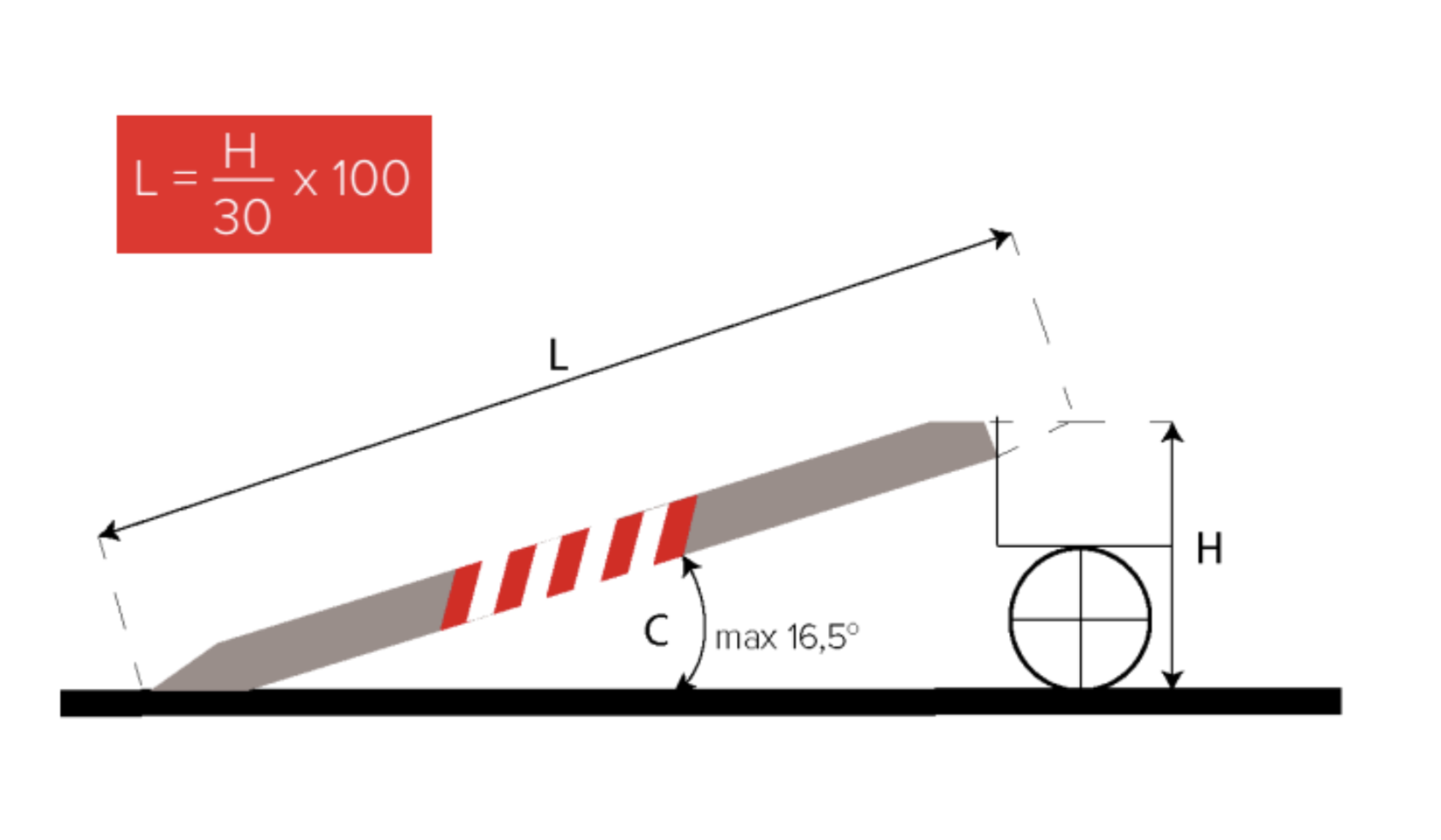
L = length
H = loading height
C = climb percentage 30 %
For safety reasons, do not exceed a maximum slope of 30% = 16.5 degrees.


